Why Autistic People Stim — And Why Stopping Them Is the Wrong Goal: A Clinician's Guide
Stimming is not a problem behaviour to eliminate — it is how autistic nervous systems self-regulate. A clinician's guide to understanding and supporting it.
OwnmindedPublished 13 min read

AI-generated illustration
Introduction
If you have spent time around an autistic child or adult, you have probably witnessed it: the rhythmic rocking, the hand flapping, the hum repeated quietly under the breath, or the fingers tracing a pattern only they can see. And if you were in a school, a clinic, or a workplace, you may have seen the next move — the adult in the room asking them to stop.
That intervention, however well-intentioned, is almost always the wrong one.
Stimming — short for self-stimulatory behaviour — is one of the most misunderstood aspects of autistic experience. It sits at the intersection of sensory processing, emotional regulation, communication, and identity. For decades it was treated as a problem behaviour to be extinguished. Emerging research and, crucially, the testimony of autistic people themselves, tell a very different story.
This article explains what stimming is, why autistic nervous systems rely on it, how suppression causes harm, and what clinicians, educators, parents, and employers can do instead.
What Is Stimming? The Basics
Stimming encompasses any repetitive movement, sound, or sensory behaviour used for self-regulation or self-expression. The term is universal: everyone stims. Clicking a pen, twirling hair, jiggling a foot, drumming fingers — these are all stims. What distinguishes autistic stimming is its purpose, intensity, and centrality to daily functioning.
A classifies stimming as a stereotypic behaviour closely associated with autism, though not exclusive to it. It appears in the DSM-5-TR diagnostic criteria under “restricted and repetitive behaviours and interests” — a framing that autistic-led advocacy has long pushed back against for its pathologising language.
Common autistic stims include:
| Type | Examples |
|---|---|
| Movement | Rocking, hand-flapping, spinning, bouncing, walking on tiptoes |
| Auditory | Humming, repeating phrases (echolalia), listening to a song on repeat |
| Tactile | Rubbing a fabric, stroking a surface, chewing, scratching |
| Visual | Watching spinning objects, lights, water, or patterns |
| Vocal | Sounds not intended as words, often idiosyncratic to the person |
Many autistic adults also maintain what calls public and private stims: more discreet, socially acceptable behaviours in public settings, and freer expression in private. This is already a form of masking.
The Neurology: Why Autistic Brains Stim
To understand stimming clinically, you need to understand autistic sensory processing.
Autistic nervous systems process sensory input differently — with greater intensity, less automatic filtering, and a higher baseline arousal level. The environment many neurotypical people experience as neutral is often genuinely overwhelming for autistic people: fluorescent lighting that flickers, the hum of an HVAC system, the brush of a tag against skin, dozens of simultaneous conversations.
Stimming is the nervous system’s response to that load. It functions like a rheostat — turning sensory input up or down to reach a state of regulation.
Sonny Jane, a lived-experience educator and consultant, describes it precisely in : “As stimming is often an extension of who we are, we are almost always stimming in one way or another. We might stim more often during moments when we need extra regulation from our emotions or sensory input, but we might also stim when we’re trying to focus or pay attention.”
Kieran Rose, autistic author and founder of The Autistic Advocate, frames it in terms of energy and frequency: “In my view, Stimming is inextricably linked to energy. Stimming is a physical manifestation of the regulation of Autistic emotion, thought and being.”
This is not metaphor. Stimming recruits proprioceptive, vestibular, and tactile systems to provide predictable, controllable sensory input in an unpredictable environment. The rhythm of rocking, for instance, activates the vestibular system in ways that have measurable calming effects. It is not defiance, not distraction, not a “bad habit.” It is neurological self-management.
Stimming Serves Multiple Functions
Clinicians sometimes reduce stimming to “anxiety relief,” but the picture is richer:
1. Sensory Regulation
The primary function. Stimming provides controllable input that helps modulate an overloaded or under-stimulated nervous system. Research from 2013 in links rocking specifically to social disconnection management — the body literally using rhythmic self-stimulation to soothe an overwhelming social environment.
2. Emotional Expression and Communication
Stimming communicates what words often cannot. Excitement, joy, distress, anticipation — all of these manifest somatically in autistic people. Sara Gibbs, autistic writer and comedian, explains: “If I see something I’m excited by, I’ll flap. If I’m distressed or trying to calm myself down, I might rock.” For non-speaking autistic people, stimming can be the primary emotional language available.
3. Focus and Cognitive Performance
This surprises many parents and clinicians: stimming frequently enhances concentration, not impairs it. Alex Lowery, autistic public speaker and author, writes: “Stimming is also something which helps me focus on the things that I’m interested in. A lot of the things that I’m good at… wouldn’t be here if it wasn’t for my Stimming.”
This maps to what occupational therapists call sensory diet theory — the idea that the nervous system performs optimally with the right quality and quantity of sensory input. A child rocking during a lesson is often regulating in order to listen, not tuning out.
4. Pleasure and Joy
Stimming is not only reactive. Many autistic people describe deeply pleasurable stims — experiences of flow, release, and euphoria. Sonny Jane puts it directly: “If I’m excited, stimming feels like an extension of my joy. It’s a natural behavior that feels like a part of me.”
Kieran Rose describes returning to suppressed stims as an autistic adult: “Embracing Stims that I never realised were Stims, felt utterly incredible. Moving in ways that I have not done in years, felt so good and surprisingly easy.”
The Harm of Suppression
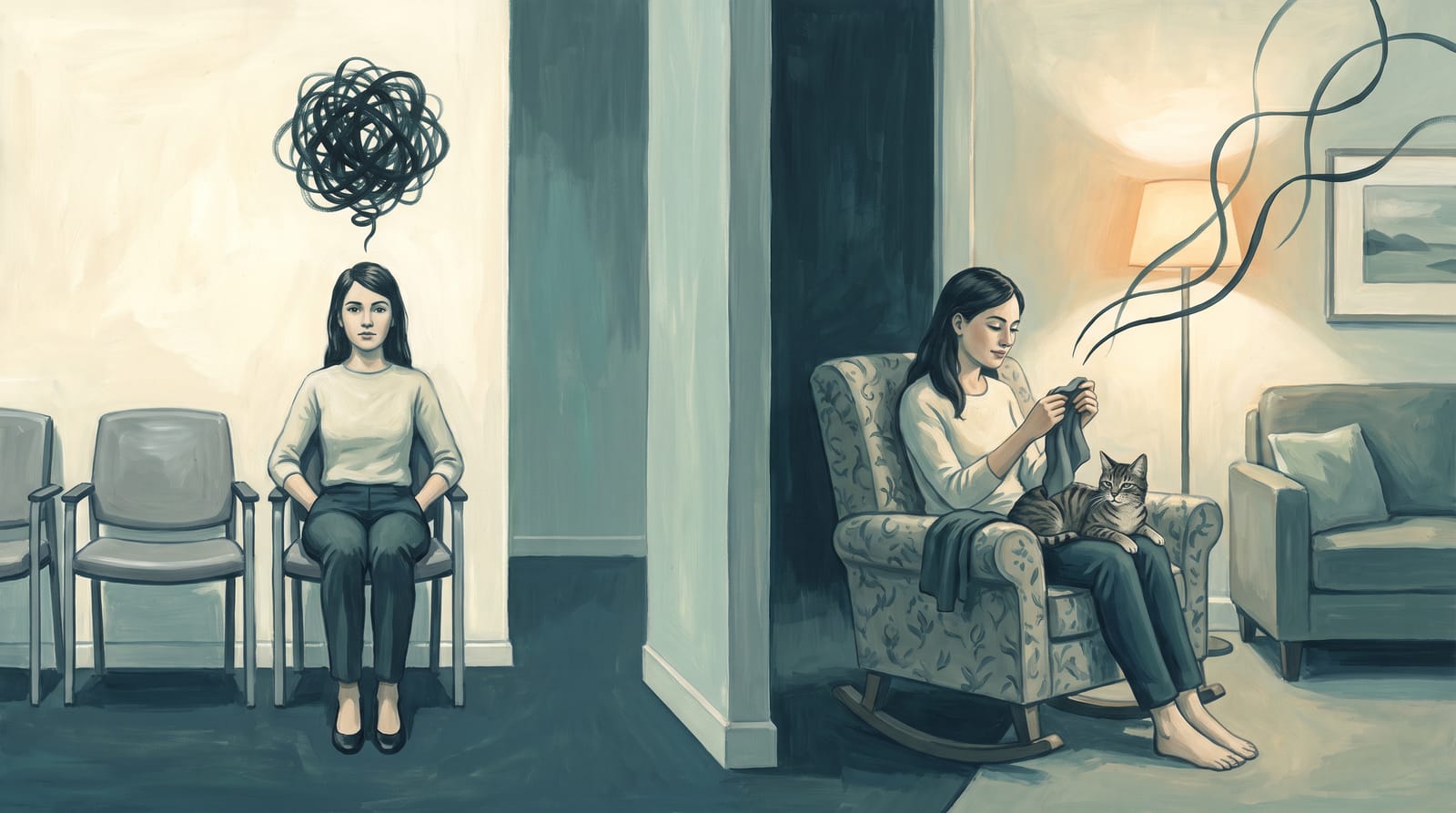
AI-generated illustration
The research and lived testimony converge on a clear finding: attempts to eliminate stimming cause harm.
Redirected Anxiety Has Nowhere to Go
When a stim is stopped without addressing the underlying sensory or emotional need, the pressure does not disappear — it builds. notes that inability to stim can lead to migraines, gastrointestinal problems, and escalating anxiety. Alex Lowery confirms: “Some of the autistic people I’ve heard about who managed to completely stop stimming have a lot of severe anxiety, which I believe partly comes from not Stimming, because they don’t have that way of de-stressing.”
Suppression Accelerates Masking — and Burnout
Teaching an autistic person not to stim is teaching them to mask. And masking — the effortful performance of neurotypical behaviour — is now well-established as a primary driver of autistic burnout: a state of profound exhaustion, skill loss, and emotional collapse that can take months to years to recover from.
The Historical Record on Behavioural Suppression
Applied Behaviour Analysis (ABA), historically used to eliminate stimming, has faced serious scrutiny. A study of 460 autistic adults, published in , linked ABA exposure to increased PTSD symptoms in autistic adults. The autistic community’s opposition to compliance-based approaches is not fringe — it is evidence-informed. The goal should never be elimination. It should be understanding.
Alex Lowery captures the core clinical error precisely: “Some people seem to think that if you can get rid of the outward behaviours of autism you get rid of autism. This is just not true.”
Special Interests: Stimming’s Close Cousin
Autistic special interests — sometimes mislabelled “obsessions” — share important neurological and functional overlap with stimming. Both are forms of deep, focused engagement with a particular stimulus, and both serve regulatory functions: lowering anxiety, building competence, and creating reliable zones of safety and joy in a frequently overwhelming world.
Chris Bonnello, autistic teacher and founder of Autistic Not Weird, argues compellingly against the pathologising of special interests: “Instead of encouraging autistic people away from their obsessions, recognise them as actual legitimate interests which may be secretly doing them a world of good.”
Clinically, this matters. Special interests and stims are neurological strengths — areas where the autistic brain operates with remarkable focus, depth, and persistence. Suppressing either is suppressing a native mode of thriving.
Stimming, Masking, and Gender
The picture of stimming is shaped significantly by gender and social expectation.
Autistic girls and women have historically been under-diagnosed in part because their stims are often more socially camouflaged: hair-twirling instead of hand-flapping, intense reading or fan engagement instead of pacing. Kieran Rose notes that girls can “often redirect Stims into things like hair twirling, which again for girls is socially acceptable” — meaning the stim is invisible, the masking is deeper, and the diagnostic gap widens.
Intersectional risk compounds this. An autistic Black person who stims visibly in public faces not only social stigma but potential safety risks. Kieran Rose names this directly: “Can you imagine then if you are Black and your risk of arrest, already exponentially higher, now has ‘behaviour’ like this added to it?” Clinicians working with autistic people from marginalised communities must hold this context — safety masking is real, it is heavy, and it has a physiological cost.
When Stimming Does Need Clinical Attention
Most stimming is benign and should be accommodated. However, there are situations where clinical assessment is appropriate:
Self-injurious stimming — head-banging, skin-picking until bleeding, biting — requires immediate attention. The goal is never suppression but understanding the underlying distress and finding substitute stims that meet the same sensory need safely. Deep pressure, weighted blankets, or firm tactile input often serve as viable alternatives to skin-based harm stims.
Sudden change in stimming pattern can signal pain, illness, or a significant increase in environmental or emotional load. A useful clinical question: what has changed in this person’s life or environment?
Stimming that the autistic person themselves wants to manage in specific contexts — not eliminated, but flexibly redirected. Alex Lowery distinguishes clearly: “I believe every person on the spectrum should still be able to have his or her own time to Stim.” The autistic person’s own preferences must lead.
Practical Strategies: Supporting, Not Suppressing
For Clinicians and Educators
- Audit the sensory environment first. Harsh lighting, open-plan noise, tight clothing with tags — these are often the source of the dysregulation that stims are managing. Reduce the load before addressing the stim.
- Create stim-friendly spaces. A quiet corner, a fidget tool, permission to rock or hum — these small accommodations can transform a person’s ability to function and learn.
- Never use punishment or physical restraint to stop stimming. This is not only ineffective; evidence links it to trauma.
For Parents and Carers
- Establish safe stim times and spaces — not as a restriction, but as an explicit gift of freedom. Many autistic people manage public stims at significant personal cost; a “stim safe zone” at home is a form of genuine care.
- Learn to read what the stim is communicating. A child rocking gently in a corner after school is decompressing. A child rocking frantically and becoming unreachable is in distress. The stim is language.
- Give warning before changes. Routine disruption is a major stim trigger. A five-minute warning, a visual timetable, or a printed map of a new route are low-cost, high-impact accommodations.
For Autistic Adults
- If you have suppressed stims to conform, know this: the suppression has a cost, and reclaiming stims has documented benefits for wellbeing.
- Stimming in private, or finding stims that are more contextually manageable (fidget tools, subtle movement, music through earphones), are not compromises — they are adaptive strategies you can choose for yourself, not ones that should be imposed.
Summary
Stimming is not a problem behaviour. It is a neurological mechanism — the autistic nervous system’s primary tool for sensory regulation, emotional expression, focus, and joy.
Decades of attempting to suppress it through behavioural training have produced evidence of harm: anxiety, PTSD, burnout, and a generation of autistic adults who spent their childhoods learning to hide the core of who they are.
The clinical consensus is shifting, driven by autistic scholars, advocates, and communities. The direction is clear: accommodate, understand, and — where necessary — redirect to safer alternatives. Never simply stop.
As Kieran Rose writes: “Our Autistic Frequency is the music of our Universe, humming and singing. The dampening down or silencing of that music, our music, is the shutting down of a part of our mind, body and soul.”
Resources
- The Autistic Advocate – An Autistic Frequency — Kieran Rose’s landmark first-person essay on stimming, masking, and identity.
- Autistic Self Advocacy Network (ASAN) — The leading autistic-led policy organisation; key resource on neurodiversity-affirming practice.
- Ambitious About Autism – Repetitive Behaviours and Stimming — Practical, accessible overview for parents, educators, and young people.
- Kapp et al. (2019), Autism — Peer-reviewed research: ‘People should be allowed to do what they like’: Autistic adults’ views and experiences of stimming.