From Survival to Sustainability: Understanding Autistic Burnout in Working Adults
What autistic burnout is, why workplaces are high-risk, how it differs from depression, and recovery strategies.
OwnmindedPublished 11 min read
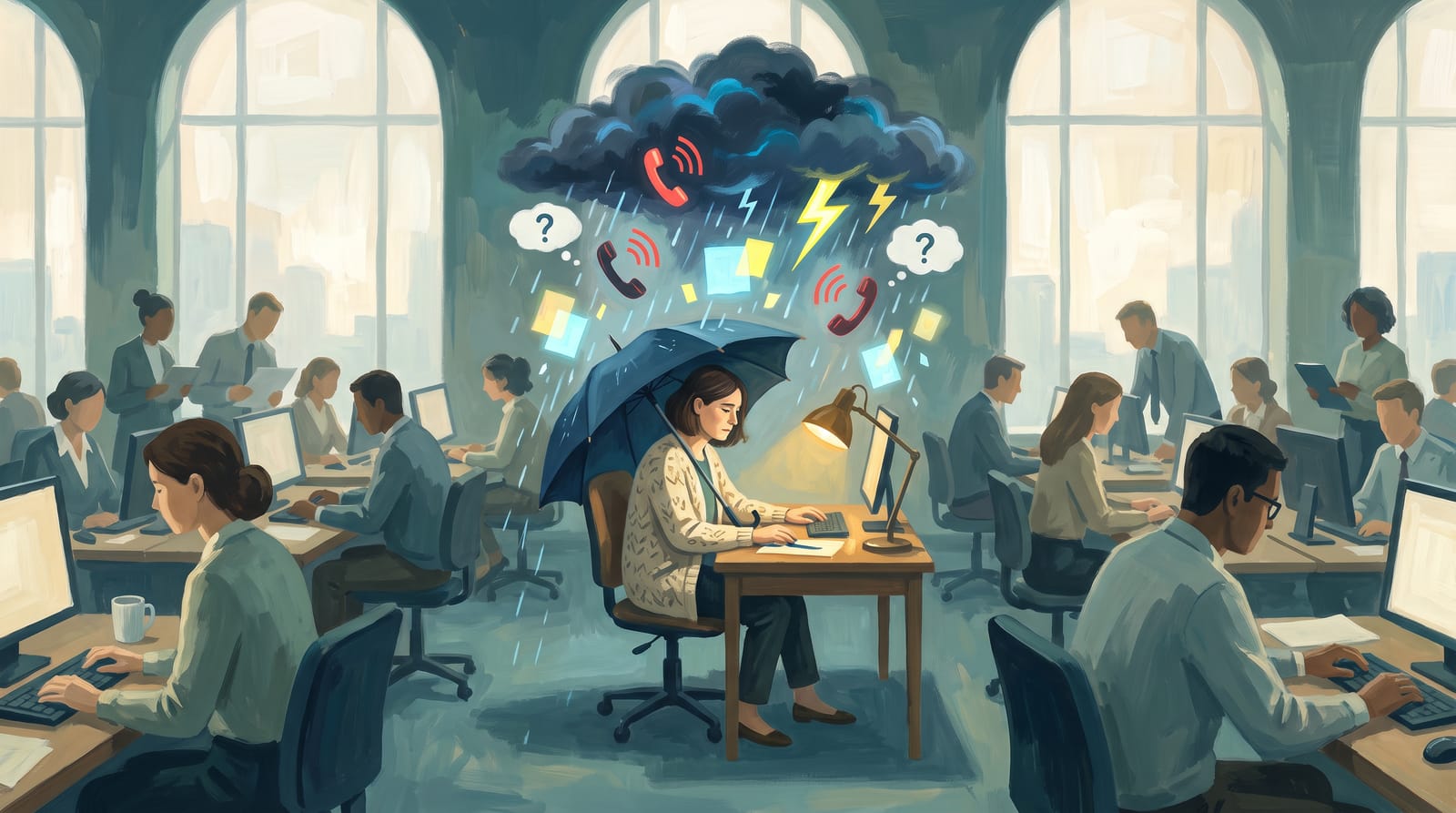
AI-generated illustration
You Are Not Imagining This
You hit every deadline. You smiled through the open-plan office noise. You decoded the vague email from your manager, held it together in the meeting, and drove home with nothing left.
Then one morning the words wouldn’t come. Tasks that were automatic last month now felt impossible. The hum of the refrigerator was suddenly unbearable. If this sounds familiar, you may be experiencing autistic burnout — and you are far from alone.
Autism is a neurodevelopmental difference in how the brain processes information, social cues, and sensory input. It is not a linear scale of “mild” to “severe” but more like a colour wheel of traits that vary from person to person. Autistic adults are often highly capable, deeply committed workers. Capability and chronic overload, however, can coexist — and when they do, the cost can be severe.
This article explains what autistic burnout is, why the workplace is a common trigger, how it differs from ordinary stress or depression, and — most importantly — what actually helps.
What Exactly Is Autistic Burnout?
In landmark research led by Dr Dora Raymaker and colleagues (2020), autistic adults defined autistic burnout as resulting from chronic life stress and a mismatch between expectations and abilities without adequate supports. The proposed definition identifies three core features:
- Pervasive, long-term exhaustion — physical, mental, and emotional. Not the kind a weekend off resolves. Typically lasting three months or longer.
- Loss of function — skills that once felt automatic, such as organising tasks, speaking clearly, or managing daily routines, become significantly harder or inaccessible.
- Reduced tolerance to stimulus — sounds, lights, textures, or crowds that were once manageable can feel overwhelming or even painful.
Later studies added features many autistic people recognise immediately: withdrawal from social contact, cognitive disruption such as memory problems and confusion, and a sense of heightened autistic traits when reserves are gone (Higgins et al., 2021; Arnold et al., 2023a). A 2025 systematic review by Ali and colleagues, synthesising 48 studies involving approximately 4,000 autistic people, confirmed that burnout is a coherent, measurable experience — not a vague complaint.
“Having all of your internal resources exhausted beyond measure and being left with no clean-up crew.” — An autistic person’s description, quoted in the Raymaker et al. (2020) study
Why the Workplace Is a Perfect Storm
For most adults, paid work is non-negotiable. For many autistic adults, it is also where masking, sensory load, and implicit social rules converge for hours every day.
Masking as a Survival Strategy
Masking — hiding or suppressing autistic traits to appear “normal” — is not a lifestyle choice. It is often a survival strategy learned through years of social pressure, bullying, or exclusion. Copying expected social behaviour, holding back stims, forcing eye contact, and performing “professional” communication styles all consume enormous mental energy that others never see.
Research increasingly links chronic masking to burnout: a 2025 systematic review identified chronic camouflaging as a key contributor to burnout (Ali et al., 2025). The longer and more intensely a person masks, the higher the cumulative cost.
Sensory Demands
Open-plan offices, fluorescent lighting, background chatter, strong perfumes, unpredictable interruptions — autistic people who process sensory input intensely may spend large parts of the day filtering stimulation that colleagues barely notice. This is real cognitive work, even when it appears on no job description.
Autistic brains often use a “bottom-up” processing style, meaning raw sensory data arrives with more intensity before it is filtered by higher-level brain centres. Sensory overload is a physical brain response, not a preference or a personality quirk.
Communication and Unwritten Rules
Many workplaces run on subtext: vague instructions, implied hierarchy, and tone-based feedback. Autistic communication often favours directness and clarity. When the rules are invisible, the extra work of “translating” the environment adds another layer of load.
Change and Unpredictability
Restructures, shifting priorities, new managers, return-to-office mandates — these transitions are especially costly for people who do better with predictable routines. Research consistently identifies major life transitions as common tipping points when burnout first becomes severe (Raymaker et al., 2020; Arnold et al., 2023a).
Together, these factors create a slow drift. Someone performs well for months or years while quietly draining reserves, until one more demand tips the balance.
This Is Not “Just” Depression or Regular Burnout
Getting this distinction right matters — because the wrong framework leads to interventions that can make things worse.
Occupational burnout typically involves exhaustion, cynicism, and reduced accomplishment tied to a specific job. Autistic burnout is more pervasive — it crosses all areas of life — and is uniquely driven by sensory overload, masking, and loss of previously reliable skills.
| Aspect | Autistic Burnout | Occupational Burnout | Depression |
|---|---|---|---|
| Driven by masking and sensory mismatch | Yes | No | No |
| Primarily tied to workplace stressors | No | Yes | No |
| Low mood/anhedonia is a core defining symptom | No | No | Yes |
| Typical scope of impact | Across work, home, and daily function | Most visible in work context | Across most life domains |
| Common first-line support focus | Load reduction + accommodations | Workload/job redesign + recovery | Mood-focused clinical treatment plan |
Depression can look similar from the outside, and the two often co-occur. Arnold and colleagues (2023a) found that many autistic people in burnout had previously been misdiagnosed with depression, anxiety, bipolar disorder, or borderline personality disorder. Standard depression treatments that emphasise increasing activity or social contact can add load to an already overwhelmed nervous system unless sensory needs and masking are addressed first.
Clinicians now have burnout-specific tools: the AASPIRE Autistic Burnout Measure (Bougoure et al., 2026) and the Autistic Burnout Severity Items (Arnold et al., 2023b) both screen for autism-specific features that generic depression and job-burnout scales miss. The point is not labels for their own sake — it is matching support to what is actually happening.
Who Is Most at Risk — and Who Gets Overlooked
Autistic burnout does not look the same in every body. Women and people of marginalised genders are disproportionately late-diagnosed and often mask more intensely, raising their cumulative risk (Ali et al., 2025). For BIPOC autistic adults, “safety masking” — code-switching across both neurotype and race — adds another layer of suppression that is rarely acknowledged in clinical settings.
Alexithymia — difficulty identifying and describing one’s own emotions — also increases risk. If you cannot easily notice that you are approaching your limits, it becomes much harder to intervene early, giving burnout more room to take hold (Ali et al., 2025).
People who are AuDHD (autistic and ADHD) face a distinctive push-pull: ADHD-driven urgency can override the autistic need for rest, making it harder to pace and easier to crash.
The Path Forward: Recovery and Prevention

AI-generated illustration
Recovery is possible, but it is often slow, uneven, and deeply personal. It may involve grief about old expectations and rebuilding a sustainable life rather than snapping back to a previous pace. None of these steps replace individualised medical or mental health care when needed — but research participants and clinical experience converge on several themes.
1. Build an Accurate Framework for Self-Understanding
Ali and colleagues (2025) identified this as a key recovery factor. Knowing what autistic burnout is — having language for it, understanding it is not laziness or moral failure — can completely change how you relate to your experience. For many adults, receiving an autism diagnosis is itself part of recovery.
2. Reduce Load and Protect Energy
Time off, fewer optional commitments, clearer boundaries, and saying no where possible are not indulgences during burnout — they are often necessary for the nervous system to recover.
3. Seek Workplace Adjustments
Reasonable accommodations — noise-cancelling headphones, flexible scheduling, written instructions, quieter workspace, remote-work options — address the mismatch between environment and needs. In many countries these are a legal right, not a special favour.
4. Reclaim Sensory Regulation and Autistic Strengths
Stimming, special interests, predictable routines, and sensory-friendly spaces are not luxuries — they are part of stabilising and healing. Special interests in particular can be a lifeline: a way to re-engage with the world through something that genuinely energises rather than drains.
5. Spend Time Unmasked
Find relationships, communities, or peer connections where your autistic traits do not have to be performed for safety. Connecting with other autistic people — online or in person — can validate lived experience and lower the load. Unmasking is not equally safe for everyone; the goal is to steadily grow the number of contexts where you can be more fully yourself.
6. Work with Informed Professionals
Therapists and clinicians who understand autism can help with boundaries, advocacy, and coping strategies. Occupational therapists and speech-language professionals sometimes address sensory processing, routines, and communication in ways that reduce long-term strain. The key word is informed — a provider who does not recognise autistic burnout may inadvertently prescribe more of what caused it.
A Note on Safety
Research has linked autistic burnout to serious mental health risk, including suicidal ideation. Arnold and colleagues (2023a) found that 52% of respondents identified suicidal thoughts as a consequence of burnout. If you or someone you know is experiencing thoughts of self-harm or suicide, treat that as an emergency: contact local crisis services or a trusted professional immediately.
Summary
Autistic adults are often highly capable, deeply committed workers — and capability and chronic overload can coexist. Autistic burnout is what happens when demands consistently exceed coping capacity and recovery time, compounded by masking, sensory overwhelm, and environments not designed for autistic brains. Naming it accurately is the first step toward sustainable work and sustainable lives.
Greater public and clinical awareness, reduced stigma, and reasonable accommodations are not only fair — they are part of preventing harm.
Resources
- ASAN — Autistic Self Advocacy Network — Policy, resources, and community led by autistic people.
- AANE — Association for Autism and Neurodiversity — Support services for autistic adults, including career and workplace guidance.
- Neurodivergent Insights — Burnout Resource Hub — Free articles, visual guides, and the Autistic Burnout Workbook by Dr Megan Anna Neff.
References
Ali, D., Bougoure, M., Cooper, B., Quinton, A. M. G., Tan, D., Brett, J., Mandy, W., Maybery, M., Magiati, I., & Happé, F. (2025). Burnout as experienced by autistic people: A systematic review. Clinical Psychology Review, 122, 102669. https://doi.org/10.1016/j.cpr.2025.102669
Arnold, S. R. C., Higgins, J. M., Weise, J., Desai, A., Pellicano, E., & Trollor, J. N. (2023a). Confirming the nature of autistic burnout. Autism, 27(7), 1906–1918. https://doi.org/10.1177/13623613221147410
Arnold, S. R. C., Higgins, J. M., Weise, J., Desai, A., Pellicano, E., & Trollor, J. N. (2023b). Towards the measurement of autistic burnout. Autism, 27(7), 1933–1948. https://doi.org/10.1177/13623613221147401
Bougoure, M., Zhuang, S., Brett, J. D., Maybery, M. T., English, M. C. W., Tan, D. W., & Magiati, I. (2026). Measuring autistic burnout: A psychometric validation of the AASPIRE Autistic Burnout Measure in autistic adults. Autism, 30(1), 20–36. https://doi.org/10.1177/13623613251355255
Higgins, J. M., Arnold, S. R. C., Weise, J., Pellicano, E., & Trollor, J. N. (2021). Defining autistic burnout through experts by lived experience: Grounded Delphi method investigating #AutisticBurnout. Autism, 25(8), 2356–2369. https://doi.org/10.1177/13623613211019858
Raymaker, D. M., Teo, A. R., Steckler, N. A., Lentz, B., Scharer, M., Delos Santos, A., Kapp, S. K., Hunter, M., Joyce, A., & Nicolaidis, C. (2020). “Having all of your internal resources exhausted beyond measure and being left with no clean-up crew”: Defining autistic burnout. Autism in Adulthood, 2(2), 132–143. https://doi.org/10.1089/aut.2019.0079
This article is for general education and does not replace individualised medical or mental health advice. If you are struggling with exhaustion, mood, or safety, consider speaking with a qualified clinician — ideally one with experience in adult autism.