Autistic Job Interviews: Why the Format Filters People Out, and What to Ask For
Why standard interviews judge social style over skill, what the research says helps autistic candidates, and how to ask for adjustments.
OwnmindedPublished 16 min read
The interview that goes wrong before you answer
You know the job. You have done the work, or something close to it, and you have the references to prove it. Then you sit down across from a panel under bright lights, someone asks “Tell me about yourself,” and you spend the next hour trying to look at the right face while guessing what they actually want to hear. A week later, the email says they went with someone else.
The standard job interview tests how you come across more than whether you can do the job, and that screens out many capable autistic people. Research on mock interviews shows where the format goes wrong, and it also points to small changes, like clearer questions, questions in advance and practical tasks, that narrow the gap. Knowing this lets you ask for those changes, and lets hiring managers offer them before anyone has to ask.
Why do capable autistic people keep losing out?
The employment gap for autistic people is too wide to blame on skills alone. In the UK, only around 3 in 10 autistic people have any paid work at all, and even graduates struggle.
Those who do find work are more likely than any other disabled graduates to be overqualified for it, on zero-hours contracts, or in a role that is not permanent.
A pattern like that points at the gate, not at the people trying to get through it. Henry Gordon, an autistic stage manager and writer from Calgary, counted roughly a dozen interviews and no offers from any of them. The jobs he did get came another way.
If the same person can be hired through temping but not through a panel, the interview itself may be doing the filtering. So what, exactly, are interviewers responding to?
What interviewers are really judging
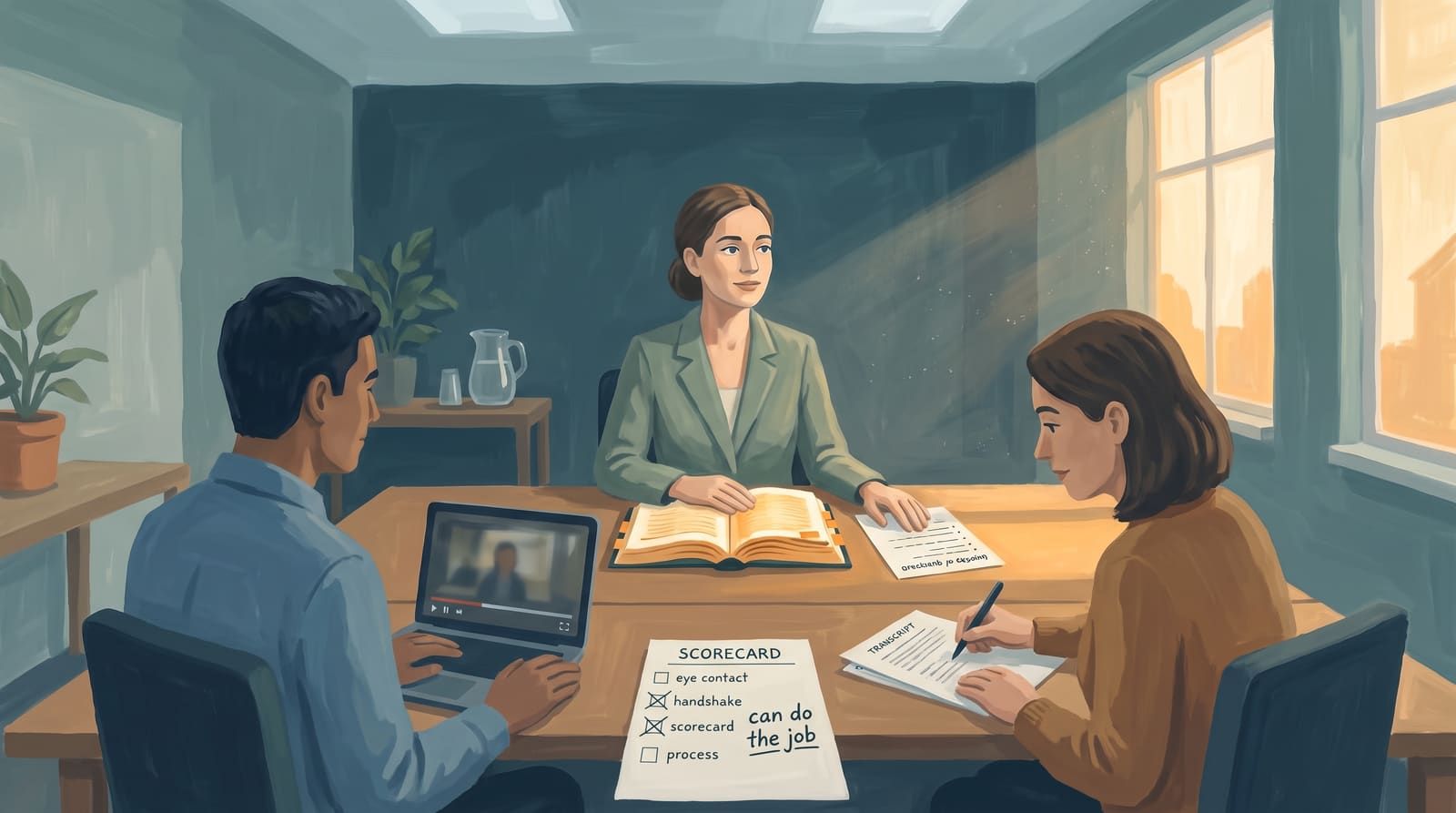
When the visual and social cues are removed, autistic candidates often look like the stronger hire. In one study, autistic and non-autistic adults were filmed in mock job interviews. Raters who watched the videos preferred the non-autistic candidates. Raters who read only the transcripts, the same words with no faces or voices, preferred the autistic ones.
The reason is how fast people judge each other. Snap impressions of competence, honesty and likeability form from minimal information, such as eye contact or a handshake, and they may be linked to hiring and even promotion decisions for years. Autistic facial expression, gesture and tone are different, not worse, but an interviewer who does not know that may read them as odd, awkward or even deceptive.
That is why so many autistic candidates feel they have to mask, hiding their autistic traits, to succeed. The UK government’s Buckland Review of autism employment, drawing on a survey by the charity Autistica and University College London, found interviews often put the emphasis on social skills rather than job skills.
Masking can work for an hour, and some people get hired that way. One autistic participant in a UK study described learning to predict the questions and running “a prepared script” for “a perfect performance.” Those who could not mask, the same study found, struggled to get work at all.
A process that rewards the best performer of non-autistic manners is measuring the wrong thing, and it is not only the eye contact that trips people up. The questions do too.
Vague questions ask you to read the interviewer’s mind
Many standard interview questions carry a hidden brief: the interviewer wants a particular kind of answer but does not say what it is. Autistica puts it plainly in its guide for employers.
Hypothetical questions are a particular problem. Autistic participants in a 2023 UK survey of hiring experiences named “what would you do in situation X?” as hard to answer, and one explained why. Another put the fix in one line: “Questions should be to the point – none of this reading between the lines malarky.”
Researchers at the University of Bath tested what happens when the questions change. Twenty-five autistic and 25 non-autistic adults sat two mock interviews rated by employment professionals. With standard questions, the autistic candidates were rated lower. With adapted questions, everyone was rated higher, and the autistic candidates improved most, so the gap between the groups shrank.
The adaptations were not only in the wording. The table shows how one question changed, and how the way it was asked changed with it.
| Aspect | Standard | Adapted |
|---|---|---|
| The question | What experience do you have of managing high workloads? | Think of a time you had lots of tasks in limited time. What was the situation? What strategies did you use? Did they work? |
| What it asks for | Left for you to infer | Named: a specific example and the details wanted |
| Parts asked one at a time | No | Yes |
| Printed copy of the questions | No | Yes |
The researchers singled out the explicit request for specific details as one of the most important changes, because it took away the need to work out what the interviewer wanted.
The printed questions helped people stay on topic and see where the interview was heading. Non-autistic candidates did better too, so a clearer question is not a special favour; it is simply a better test.
Does it help to tell them you are autistic?
Knowing a candidate is autistic changes how interviewers read the same behaviour. In a 2023 study, 119 raters watched a video of an autistic person’s full mock interview. Those who knew about the diagnosis rated the candidate better on every measure, including confidence, motivation and knowledge. Adding extra information about autism did not raise ratings further.
A 2025 study went further and checked whether the effect lasts. When raters had some neurodiversity training and knew the diagnosis, autistic candidates were still rated less favourably on some social traits, such as awkwardness, but were just as likely to be hired, even after a delay.
Both studies used mock interviews and raters recruited for research, not real hiring panels, so they show what is possible rather than what every employer does.
Real experience is more mixed, and autistic people do not agree on when to say it.
Views differ
Telling the panel first
Barbara Bissonnette, a coach who works with autistic adults, offers a middle rule. If something about how you interview is noticeable enough to count against you, such as needing a few seconds to organise your thoughts, a short explanation can stop it being misread. If it is not noticeable, disclosing can draw attention to problems instead.
Disclosure is a tool you can pick up or leave, and the choice is yours. Changing the questions only goes so far, though, which raises a bigger question about the format itself.
Better than an interview: show the work
Many autistic job seekers say the fairest test of a job is doing a piece of it. Practical methods such as work trials were among the improvements participants recommended in the 2023 UK survey, and those who had done them described them warmly.
Autistica asks employers to question the format directly: is a standard interview needed for this job at all, or could a task show more? It also suggests offering a choice between meeting in person, by phone or by video.
Supported work placements show what can happen when people get to prove themselves on the job. In a trial led by Paul Wehman at Virginia Commonwealth University, 31 young autistic adults did three 10-week hospital internships. Three months later, 90 percent were working part-time at the hospital, compared with one of the 18 young people who stayed in their usual school programmes.
This was one small trial of young adults, reported in a news feature, and an internship is a bigger commitment than a work trial. It still points the same way as the survey: when the test is the work, more autistic people end up in work.
Not every employer will rebuild its hiring process for you. That is where the law comes in.
What the law says you can ask for
In both the UK and the US, adjustments to the hiring process are a legal right, not a kindness. UK government guidance lists changing the recruitment process among the reasonable adjustments employers must make so a disabled candidate is not at a substantial disadvantage.
An employer can ask whether you need an adjustment, or wait for you to say, but if an adjustment is reasonable, it must be made.
Arwen Makin, writing for the Law Society, notes that many recruitment adjustments cost little or nothing, and that something as simple as understanding that eye contact may be hard for an autistic person counts. Failing to make them risks breaching the Equality Act.
In the US, the Americans with Disabilities Act covers the interview as well as the job.
Employers should not ask whether you have a disability in a pre-offer interview, and they must keep any medical information you share confidential.
There are limits. There is no fixed list of accommodations an employer must grant; each request is judged case by case, what counts as reasonable depends partly on the size of the company, and an employer may offer a different fix that meets the same need. This is general information rather than legal advice. What it means in practice is that a clear, specific request is more likely to succeed than a general one.
What helps
The adjustments with the most behind them are also the cheapest. These come from Autistica, the University of Bath and EARN, a US network that advises employers on disability.
If you are the candidate
Asking for interview adjustments
-
Decide what would let you show your skills. Common requests include the questions in advance (Autistica suggests a week), questions that ask for specific examples, multi-part questions asked one part at a time, and a printed copy of the questions to refer to.
-
Ask about the setting too. You can ask for the panel’s names and roles, the route, where to wait and where the toilets are, or for the interview by phone or video if that suits you better.
-
Ask whether a task or work trial is possible, especially if the job is practical.
-
Name the solution, not just the difficulty. Most hiring managers know little about autism, so a list of problems leaves the work to the people who know least about what you need.
-
Be specific. Say what you need and why in one sentence, such as needing a few seconds to organise your thoughts before you answer.
That fourth step is Bissonnette’s core advice. A request framed as a fix gives the employer something to say yes to.
If you are hiring
Beyond that, structure the interview, explain in advance what will happen, and consider sending the questions ahead. Autistica points out that sharing questions benefits every candidate, neurodivergent or not, which makes it an easy default rather than a special arrangement.
A fairer test is a better test
The research keeps landing in the same place. When interviewers read the words instead of watching the face, when the question says what it wants, and when the task is the work itself, autistic candidates are rated better, and in the Bath study non-autistic candidates did better too. The gap is not explained by ability alone; the format plays a large part. That means you do not need to perform harder. You can ask for a test that measures what the job needs, and an employer who wants the best person has every reason to give it.
- Autistica: Inclusive interviews(opens in a new tab)
An employer's guide to clearer questions, information in advance and alternatives to the standard interview.
UK
- University of Bath: Interviewing an autistic person(opens in a new tab)
Katie Maras's research-based guide for interviewers, including how to adapt questions.
UK
- GOV.UK: Recruitment and disabled people(opens in a new tab)
Official guidance on employers' duty to make reasonable adjustments during recruitment.
UK
- EARN: Job descriptions and interviewing(opens in a new tab)
US guidance on structured interviews, accommodations and disclosure rights for neurodivergent applicants.
US
Get new articles by email
One short email when we publish something new. Evidence-informed writing on autism in adulthood, no spam.
Sources (15)
- Whelpley and May (2023). Seeing is Disliking: Evidence of Bias Against Individuals with Autism Spectrum Disorder in Traditional Job Interviews. Journal of Autism and Developmental Disorders.
- (2025). How Long Does it Last? The Enduring Benefits of Neurodiversity Training and Diagnostic Disclosure on Hiring Outcomes for Adults with ASD. Journal of Autism and Developmental Disorders.
- Norris, Prosser, Remington, Crane and Maras (2023). Disclosing an autism diagnosis improves ratings of candidate performance in employment interviews. University of Birmingham repository.
- UK government. The Buckland Review of Autism Employment: report and recommendations. GOV.UK.
- Henry Gordon (2022). Autism makes me great at my job, but horrible at interviews. CBC News, First Person.
- Autistica. Employers Guide to Neurodiversity: Inclusive interviews. Autistica.
- University of Bath (Katie Maras). Adapting job interview questions for autistic candidates (summary). University of Bath.
- Davies, Heasman, Livesey, Walker, Pellicano and Remington (2023). Access to employment: A comparison of autistic, neurodivergent and neurotypical adults' experiences of hiring processes in the United Kingdom. Autism.
- The Transmitter. Work in progress: an inside look at autism's job boom. The Transmitter.
- Barbara Bissonnette (2015). Understanding Disclosure and Workplace Accommodations. Oaracle newsletter, Organization for Autism Research.
- EARN. Including Neurodivergent Workers: Job Descriptions and Interviewing. Employer Assistance and Resource Network on Disability.
- Arwen Makin (2022). From access to inclusion: neurodiversity at work. Law Society of England and Wales.
- Katie Maras. What to do when interviewing an autistic person for a job. University of Bath.
- GOV.UK. Reasonable adjustments for workers with disabilities or health conditions. UK government.
- GOV.UK. Recruitment and disabled people: Reasonable adjustments. UK government.
How we research and write our articles: Editorial policySources & methodologyMedical disclaimer