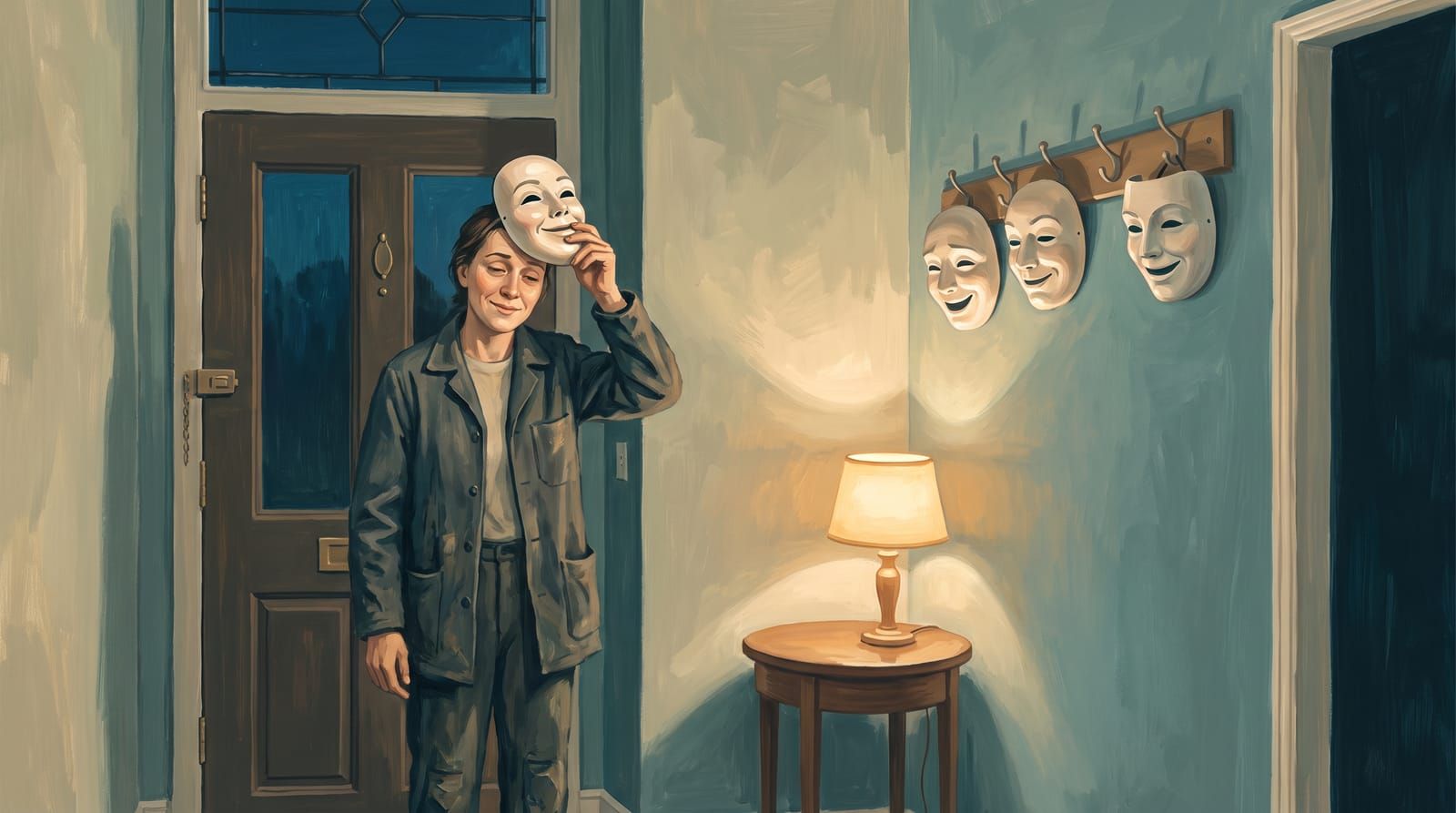
"I Don't Know What I Feel": Alexithymia and Interoception in Autism
Why many autistic people notice hunger, thirst or emotions only when they are urgent, and how outside cues can help.
OwnmindedPublished 11 min read
You are not imagining this
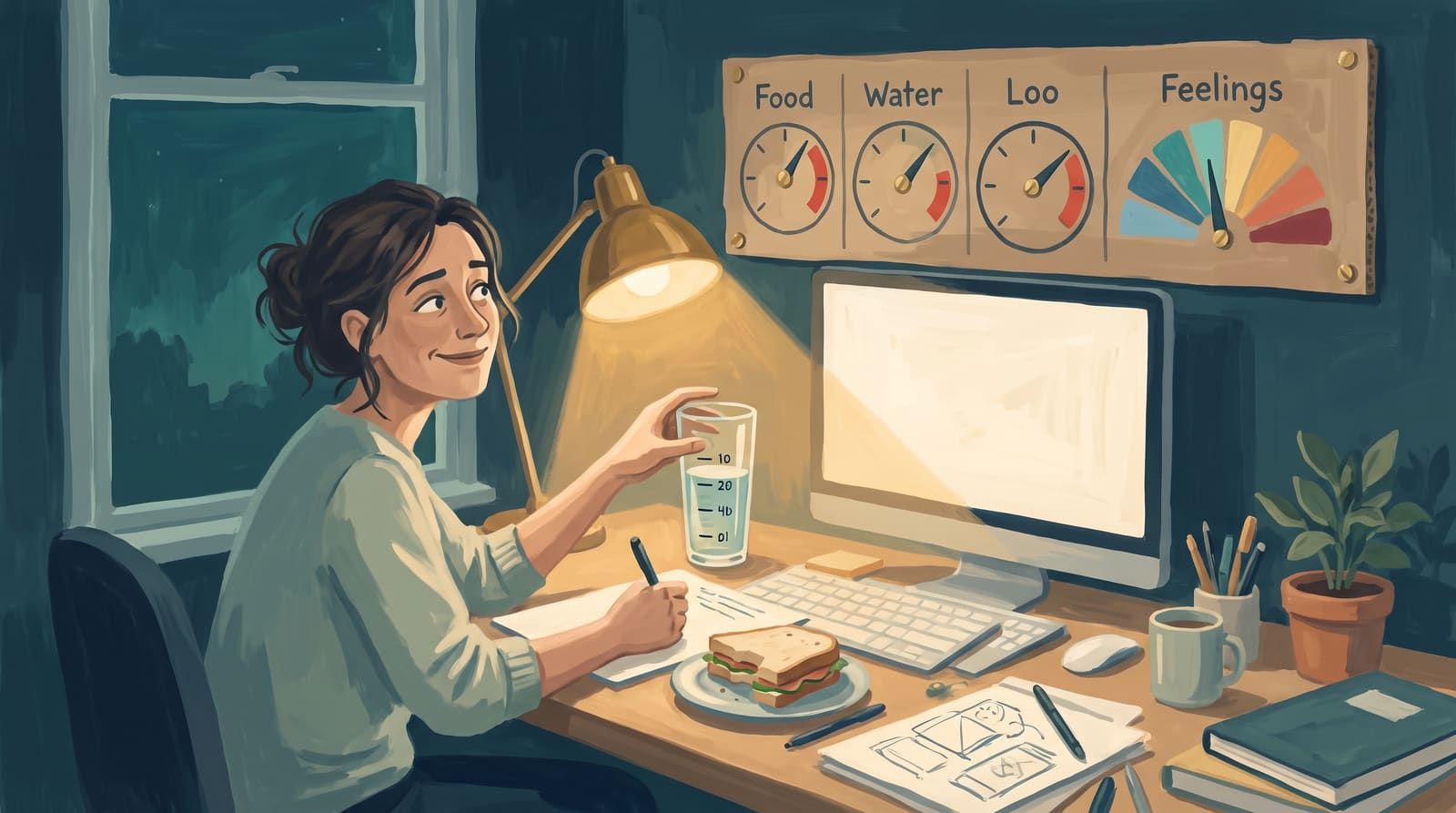
You look up from your screen and it is dark outside. You have not eaten since breakfast, your head aches and you suddenly need the loo, badly. Later someone asks how you are, and you honestly do not know. For many autistic people, body signals and feelings arrive late, loud or not at all.
This is not carelessness and it is not a lack of feeling. It is linked to two documented differences: interoception, the sense of your body’s inner state, and alexithymia, difficulty identifying your own emotions. This article explains both, how they show up day to day, how they connect to meltdowns and burnout, and what helps.
What are interoception and alexithymia?
Interoception is the perception of signals from inside your body: hunger, thirst, heart rate, tiredness and muscle tension. Reframing Autism calls it “the eighth sense”, because it is how people make sense of both their physical and emotional states .
Alexithymia is difficulty identifying, understanding and describing emotions. It is a personality trait, not a mental health condition. Researchers describe three core features :
- Difficulty identifying feelings: you sense something is happening inside, but not what it is.
- Difficulty describing feelings: putting an emotion into words is hard.
- Externally oriented thinking: attention goes to the outside world rather than to inner states.
The two are closely tied, because interoception is part of how people interpret emotions as well as physical states. If body signals are hard to read, the emotions behind them can be hard to read too.
How common is it in autistic people?
A 2026 scoping review found that about 49.9% of autistic people have clinically significant alexithymia, compared with around 10% of the general population.
- Autistic people
- 49.9%
- General population
- 10%
The same review suggests that some emotional differences long put down to autism itself may come from co-occurring alexithymia instead, which calls for different kinds of support .
Interoception differences are common too. 74% of autistic adults reported interoceptive confusion when asked to identify body signals . The pattern varies a lot from person to person:
- Hypo-awareness: body signals feel faint or go unnoticed.
- Hyper-awareness: body signals feel over-sensitive and intense.
- Individual mixes: the pattern is highly variable, so no two autistic people are quite alike.
Neurodivergent Insights describes an interoceptive paradox. In tests, autistic people are often less accurate at detecting their own heartbeats, yet they report feeling their inner sensations more strongly . The signals can be loud without being clear.
Why do body signals and emotions get tangled?
One line of research argues that alexithymia is a general difficulty with interoception, not only a problem with emotions. People with alexithymia tend to confuse emotions with other body states, such as hunger, temperature or tiredness .
The same paper points to shared brain areas, the anterior insula and anterior cingulate cortex, which handle both body signals and emotional awareness. That overlap helps explain why the two differences so often appear together.
So the question “Am I upset or hungry?” is not a silly one. When emotions and body states are easy to confuse, telling them apart takes deliberate effort.
What does it look like day to day?
Because interoception covers every inner signal, the effects reach across daily life. Reframing Autism lists irregular eating and drinking, dehydration and delayed recognition of pain or illness among the common signs .
| Signal | What can happen |
|---|---|
| Hunger | You fail to notice it and forget to eat |
| Thirst | You go without drinking and end up dehydrated |
| Pain or illness | You recognise it later than you would expect |
| Temperature and tiredness | They get mixed up with emotions |
| Emotions | You sense something but cannot say what it is |
Rachel, a late-diagnosed autistic woman, sums up the experience: “I live from the neck up” .
Emotions can also arrive on a delay. Many autistic people with alexithymia feel something deeply in the moment but need hours or days to understand what happened inside .
Does alexithymia mean having no feelings?
No. The Autistic Girls Network explains that autistic people with alexithymia feel sadness, joy, anger and fear with full intensity; what is hard is naming them . Emily, writing for the network, asks readers to “imagine the confusion you would feel” when you cannot identify your own emotions or why you are having them.
So when an autistic person says “I don’t know” to “How do you feel?”, it is often an honest answer, not a lack of care or a way to avoid the question.
How does this connect to meltdowns and burnout?
When you cannot easily notice hunger, tiredness or rising stress, pressure can build without signals you can read. Reframing Autism lists this buildup, leading to meltdowns or shutdowns, among the signs of interoception difficulties . A meltdown that seems to come out of nowhere may have been building unnoticed.
See also our article on autistic burnout in working adults.
Naming what you feel is part of regulating it. Interoceptive awareness can be learned: Reframing Autism reports that autistic children who practised identifying body signals and linking them to emotions showed better emotional regulation afterwards .
What helps?
Support works from two directions. External cues do the noticing for you, and internal practice slowly builds awareness. The National Autistic Society says neither is better than the other, but internal awareness is worth building because outside prompts are not always available .
1. Eat and drink on a routine, not on a signal
Consistent routines for eating, drinking and self-care act as external reminders, so you rely less on internal signals .
2. Let technology prompt you
- Phone reminders and alerts: prompts for things like drinking water, alongside changes that reduce sensory overload .
- Smartwatches and heart rate monitors: outside feedback on heart rate and stress levels, which can help you interpret your inner state .
3. Use visual tracking tools
Hydration charts and Bristol stool charts give a visual record of body functions you might not notice from the inside . Emotion charts and body maps help link sensations to states, for example recognising that “a headache is related to stress or that a stomachache signals hunger” .
4. Start with the body, not the feeling
5. Practise short body exercises
Body scans and mindfulness practices can help you recognise and interpret internal signals . The National Autistic Society describes simple exercises such as belly breathing, hand breathing, shoulder shrugs and toe curls. These need practice two to three times a day for at least eight weeks, built into routines such as the morning, before leaving home and before bed .
Progress can be small and still matter. After working on interoception, Rachel said: “I realized I was tired before I started crying. That’s new for me” .
6. Keep your stims
Stimming, such as hand flapping or rocking, helps regulate the autonomic nervous system, the part that runs automatic body functions. Reframing Autism says it should be encouraged, not suppressed .
When to look for more support
Reframing Autism lists these as warning signs of interoception difficulties :
- Irregular eating and drinking, including dehydration
- Delayed recognition of pain or illness
- Difficulty connecting physical sensations to emotions
- Buildup that leads to meltdowns or shutdowns
Summary
Many autistic people notice hunger, thirst, pain and emotions late, or only when they become urgent. This is linked to differences in interoception and to alexithymia, which affects about half of autistic people. It does not mean an absence of feeling: emotions are often felt fully but are hard to name. Routines, reminders, visual tools and body-first check-ins can take over some of the noticing, and awareness can grow with practice.
Resources
- Reframing Autism: Interoception, Knowing Yourself Inside and Out(opens in a new tab)
A guide to signs and supports.
- National Autistic Society: Interoception and mental wellbeing(opens in a new tab)
Tools, exercises and assessment options.
UK
- Autistic Girls Network: Alexithymia and Autism(opens in a new tab)
What alexithymia is and is not.
- Neurodivergent Insights: Autism and Interoception(opens in a new tab)
Explainers on body signals.
Sources (8)
- Frontiers in Psychology (2026). Alexithymia in neurodevelopmental populations: a scoping review of Down syndrome, autism spectrum disorder, and dual diagnosis. Frontiers.
- Reframing Autism. Interoception: Knowing Yourself Inside and Out. Reframing Autism.
- Marsh, E. Alexithymia: What Becomes of the Broken Hearted? Reframing Autism.
- Neurodivergent Insights. Autism and Interoception. Neurodivergent Insights.
- Alexithymia: a general deficit of interoception. PubMed Central.
- Autistic Girls Network. Alexithymia and Autism. Autistic Girls Network.
- Love On The Autism Spectrum. Interoception: The Elusive Undercurrent. Love On The Autism Spectrum.
- National Autistic Society. Interoception and mental wellbeing in autistic people. National Autistic Society.