AuDHD: When Autism and ADHD Live in the Same Head
Why autism and ADHD so often come together, how routine and novelty pull against each other, and what support serves both.
OwnmindedPublished 10 min read
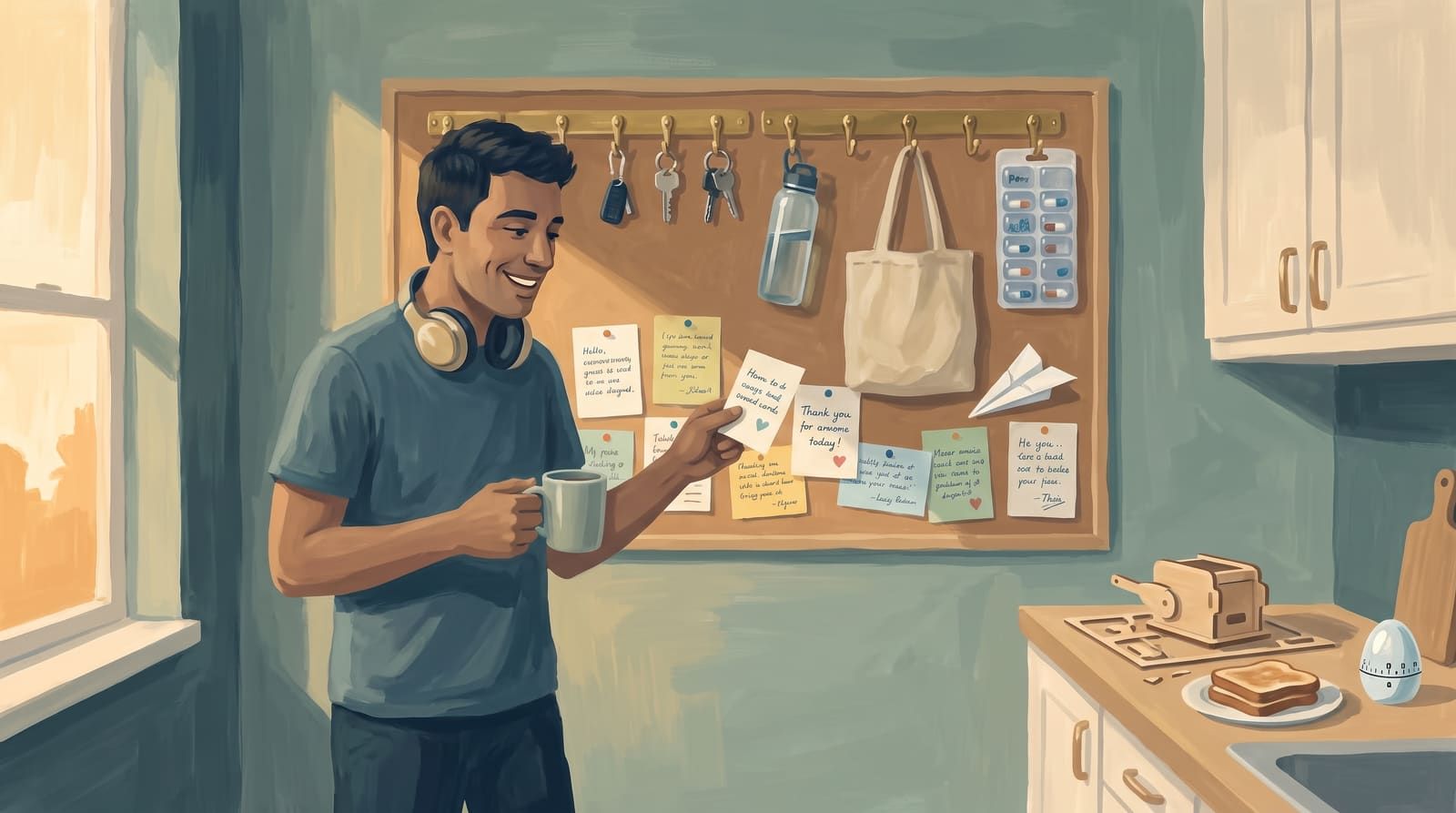
You are not imagining this
You build the perfect morning routine and it feels like relief. Two weeks later you cannot make yourself follow it. You try something new to shake things up, and now everything feels wrong. Many people who are both autistic and ADHD describe exactly this loop.
AuDHD is the community’s name for being autistic and ADHD at the same time. This article covers how common the overlap is, why it happens, what the routine-versus-novelty tension looks like day to day, and how to set up support that works for both sides at once.
What is AuDHD?
AuDHD is not a separate diagnosis. It describes a person who meets the criteria for both autism and ADHD. Formal dual diagnosis was not allowed until the DSM-5 in 2013, so for years clinicians had to pick one label or the other.
People who are AuDHD often describe a mix of traits that pull in different directions:
- Routine and predictability: the autistic side tends to need deep, steady routines and a calm environment.
- Novelty and stimulation: the ADHD side tends to seek new things, fast action and dopamine, the brain chemical linked to reward and motivation.
- Layered interests: long-lasting special interests can run alongside shorter, intense hyper-fixations that come and go.
- Sensory differences: sensitivity to sound, light or touch is common in both autism and ADHD.
- Executive function strain: planning, working memory and impulse control (the brain’s “management” skills) can be affected from two directions at once.
The community often describes the result as “a constant tug-of-war”.
How common is it?
Very common. Between 50% and 70% of autistic people also meet diagnostic criteria for ADHD, according to one meta-analysis, though individual studies range from 22% to 83% depending on how they measure it. Clinicians and researchers quoted by ADDitude give a similar range of 40% to 70%.
The overlap runs both ways. In children, roughly a third of those with autism also have ADHD, while about one in ten of those with ADHD also have autism.
- Autistic children who also have ADHD
- 33%
- Children with ADHD who also have autism
- 10%
The overlap also lasts into adulthood.
A larger study of more than 3.5 million adults found ADHD was highly elevated among autistic adults, and having both was linked to worse health outcomes.
Many people still go unrecognised. In the same research, only 16% of children who had both autism and ADHD had previously been diagnosed with both, which points to widespread underdiagnosis.
Why do autism and ADHD show up together?
The main explanation appears to be genetic. Autism and ADHD share an estimated 50–72% genetic overlap, which is likely the primary reason they so often occur together.
The two also look alike from the outside. Delayed early language, communication differences and repetitive or restricted behaviours can appear in both, which makes it easy for one to be mistaken for the other or for the second to be missed.
Inside the brain, they tend to push in opposite directions. ADHD is linked to dopamine-driven attention seeking and a preference for novelty, while autism typically involves a preference for routine and predictability.
What does the tug-of-war look like day to day?
AuDHD adults describe a pattern that repeats. You build the routine your autistic side needs, and within about two weeks your ADHD side rebels against it. Then, when you add something new to keep your attention, your autistic side goes into alarm.
Some describe routine as really hard to keep, yet they feel worse when it slips. At the same time, they need something to keep their ADHD brain engaged, or boredom sets in.
| Aspect | What the autistic side wants | What the ADHD side wants |
|---|---|---|
| Daily schedule | The same steps in the same order | Something different today |
| Interests | One deep interest held for years | A new fixation every few weeks |
| Pace and setting | Predictable and familiar | New things and fast action |
Executive function can feel harder in AuDHD than in either condition alone. Autism and ADHD affect planning, working memory and impulse control through different routes, so the effects may stack. Researchers are careful here: “Research on how autism and ADHD interact in executive function is still emerging, with much of what we know coming from clinical observation and lived experience rather than controlled studies designed specifically for this population”.
Why does support have to serve both sides?
Because each side’s needs are real, a plan that meets one set of needs can leave the other unmet. A strict routine calms the autistic side but starves the ADHD side of stimulation. Constant change feeds the ADHD side but sets off the autistic side’s alarm. AuDHD adults describe this as a paradox in which the same person’s needs directly contradict each other.
For an AuDHD person, then, the goal is a setup where both needs have a place, rather than choosing one and pushing through the other.
Who gets missed?
Some groups are missed more often. Dr Jess Hogan, an AuDHD psychologist, has spent more than a decade working with women, trans and non-binary people who are often overlooked by traditional autism and ADHD evaluations. Dr Megan Anna Neff, an autistic and ADHD clinical psychologist who founded Neurodivergent Insights, only discovered her own neurodivergence at 37.
What helps
The strategies below come from AuDHD-focused practitioners and from AuDHD adults themselves. Each one tries to give both sides something.
1. Keep a few anchors and leave open space
A flexible weekly routine can hold both needs: a small number of steady anchors give the autistic side predictability, and open blocks leave room for novelty, spontaneity and interest-led time for the ADHD side.
2. Change the method, not the content
3. Build variety into familiar structure
AuDHD adults describe trying different options inside a fixed slot, such as a different snack at the same time each day. The time is predictable; the choice is new.
4. Plan sensory support for both sides
Sensory processing differences affect 42–88% of autistic children and about half of those with ADHD, so sensory support is a shared priority. Practical steps include:
- Timing: schedule sensory input before demanding tasks, not after.
- A small toolkit: keep two items ready, such as headphones and a chew.
5. Look after the basics that feed both
Consistent sleep, protein-forward meals and short bursts of movement support both energy and attention regulation in AuDHD.
6. Work with practitioners who understand both
Modified cognitive behavioural therapy (CBT, a talking therapy focused on thoughts and habits) and occupational therapy from practitioners who specialise in dual diagnosis can make a large difference for AuDHD adults.
Summary
Autism and ADHD occur together often, likely because they share a large part of their genetics, yet many people are only ever diagnosed with one. AuDHD brings a daily pull between the autistic need for routine and the ADHD need for novelty. Support that serves only one side tends to fail the other. What works is structure with built-in change: steady anchors, open space, fresh methods for familiar tasks, and sensory support that fits both.
Sources (10)
- ADDitude Magazine. AuDHD: Stories of Life with Autism and ADHD.
- ScienceDirect. Prevalence of attention-deficit/hyperactivity disorder in individuals with autism spectrum disorder: A meta-analysis.
- Children's Hospital of Philadelphia. Rates of ADHD Remain High into Adulthood Among Patients with Autism.
- Behavioral Innovations. The Sudden Rise of AuDHD: Coexistence of ADHD and Autism.
- ScienceInsights. Do ADHD and Autism Overlap? Genetics and Brain Traits.
- Life Skills Advocate. AuDHD and Executive Function: What Happens When Autism and ADHD Share One Brain.
- Neurodivergent Insights. Adult Autism & ADHD Assessments: What to Expect & Ask.
- Haven Health / Dr. Lana Ferris. The AuDHD Paradox: 5 Lived Experiences of Autism and ADHD.
- ScienceWorks Health. AuDHD Routines: When Structure Fights Novelty.
- Respect the Autistic (2026). AuDHD, Autism & ADHD: Different Profiles, New Research.